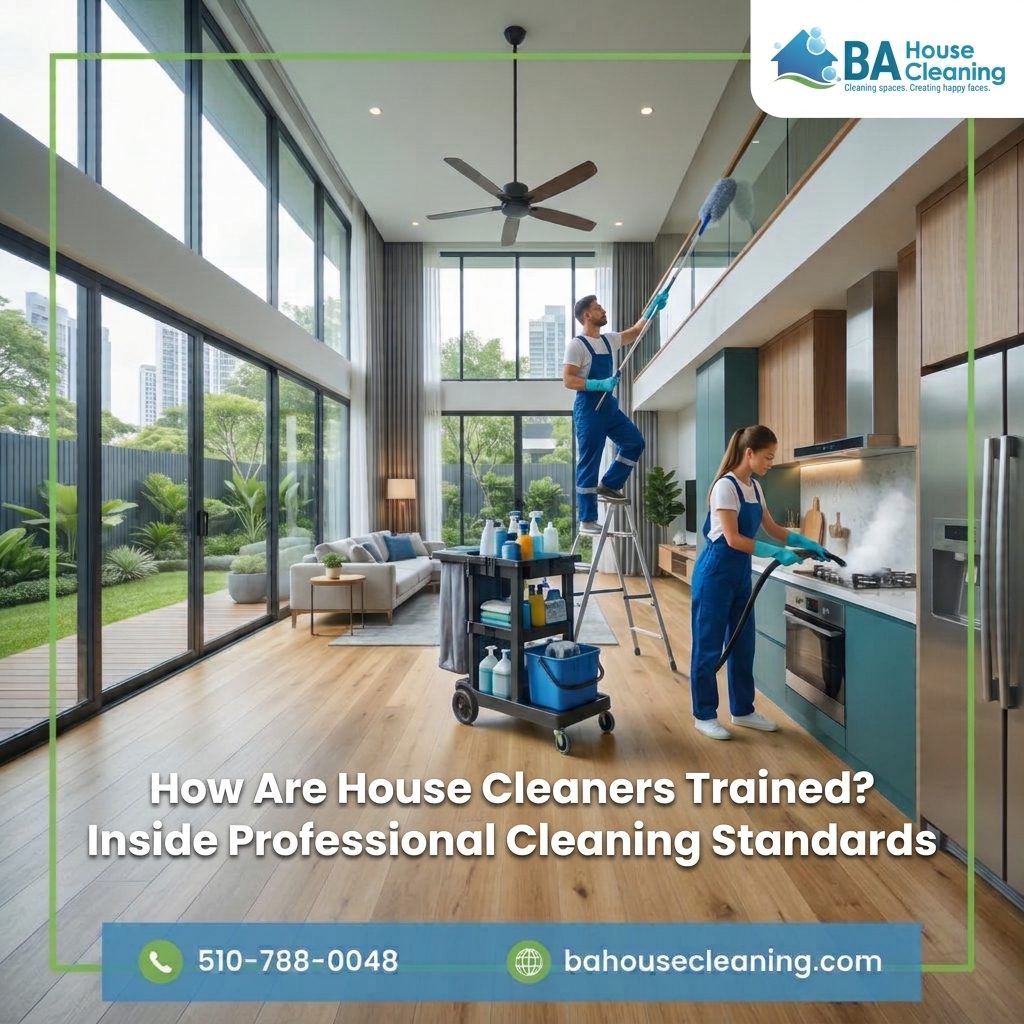
How are house cleaners trained? Professional house cleaners typically learn through practical instruction, hands-on experience, cleaning safety procedures, and standardized cleaning methods. Training covers everything from choosing the right products for different surfaces to following room-by-room cleaning procedures and respecting homeowners’ personal spaces.
At BA House Cleaning, professional preparation is supported by experienced employees and our structured cleaning approach, known as the BAHC Way.
But what does house cleaner training actually involve, and how can homeowners recognize a well-prepared cleaning professional?
What Does Professional House Cleaner Training Include?
Professional house cleaner training goes beyond learning how to dust furniture or mop floors. Cleaners need to understand different household materials, appropriate cleaning techniques, equipment handling, and customer expectations.
A comprehensive training program generally develops four core skills:
Cleaning techniques: Learning effective methods for dusting, vacuuming, mopping, and cleaning kitchens, bathrooms, and living areas.
Surface care: Understanding how to clean hardwood, tile, natural stone, glass, and other materials without unnecessary damage.
Cleaning product safety: Reading product labels, using equipment correctly, and avoiding potentially dangerous chemical combinations.
Professional conduct: Respecting homeowners’ belongings, following instructions, communicating clearly, and protecting privacy.
These skills help cleaners approach different home environments with greater confidence and consistency.
How Are House Cleaners Trained? The Typical Learning Process
Although training procedures differ between cleaning companies, professional preparation usually combines initial instruction, practical experience, and continued skill development.
Step 1: Learning Cleaning Safety and Product Handling
Safety is one of the first subjects a professional house cleaner should understand. Proper training helps cleaning professionals recognize potential hazards, select appropriate products, and protect household surfaces while carrying out their work.
According to the Occupational Safety and Health Administration (OSHA), employees who work with hazardous cleaning chemicals must receive appropriate information and training about chemical risks, safe handling procedures, and protective measures.
Professional cleaners should understand how to read product labels, follow manufacturer instructions, and avoid using incompatible chemicals.
For example:
Bleach should never be mixed with ammonia or acidic cleaning products, as dangerous gases can form.
Natural stone surfaces, such as marble and limestone, can be damaged by certain acidic cleaners.
Hardwood floors may require gentle cleaning products and limited moisture to protect their finishes.
Disinfectants must be used according to their label instructions, including the required contact time.
Another essential part of house cleaner training is understanding the difference between cleaning and disinfecting.
The Centers for Disease Control and Prevention (CDC) explains that cleaning removes dirt and many germs from surfaces, while disinfecting uses suitable products to kill remaining germs. For most households, routine cleaning is generally sufficient unless someone is sick or additional precautions are necessary.
When disinfection is appropriate, cleaners must also understand how to apply products correctly.
The U.S. Environmental Protection Agency (EPA) emphasizes the importance of following disinfectant label directions. This includes observing the required contact time, during which the treated surface must remain wet for the product to work as directed.
Understanding these safety principles helps professional cleaners reduce avoidable risks, protect household materials, and use cleaning products responsibly.
Effective house cleaner training isn’t simply about knowing which product to use. It’s about understanding when, where, and how to use it safely.
Hands-on practice helps cleaners develop an organized approach to different parts of a home.
In kitchens, for example, cleaners may learn how to address countertops, sinks, appliance exteriors, and accessible surfaces while paying attention to material compatibility.
Bathroom cleaning requires additional attention to soap residue, water deposits, fixtures, and surfaces that may need specific cleaning products.
Bedrooms and living areas involve different priorities, including dust removal, floor care, and protecting furniture or delicate belongings.
A room-by-room approach helps establish a logical workflow rather than treating every space in exactly the same way.
Step 3: Following Professional House Cleaning Standards
Cleaning standards provide a consistent reference for completing household tasks.
A typical residential cleaning checklist may include:
Dusting accessible furniture and surfaces.
Cleaning kitchen countertops and sinks.
Wiping appliance exteriors.
Cleaning bathroom sinks, toilets, and showers.
Vacuuming rugs and carpeted areas.
Mopping appropriate hard floors.
Emptying designated household trash bins.
However, the exact tasks depend on the cleaning service and the condition of the property.
For example, cleaning inside ovens or refrigerators, detailed buildup removal, and specialized treatments may require additional arrangements.
Professional cleaners should understand the agreed scope of work before beginning an appointment.
Step 4: Developing Communication and Customer Service Skills
Technical ability is only one aspect of professional cleaning.
House cleaners also need to communicate respectfully, follow household-specific instructions, and recognize situations where they should ask questions before proceeding.
Examples include:
Understanding which rooms are included in the appointment.
Identifying fragile decorations or sensitive surfaces.
Following homeowners’ instructions regarding pets.
Respecting personal belongings and private areas.
Reporting unexpected conditions or cleaning concerns.
These professional habits matter because residential cleaners work inside spaces that homeowners consider personal and private.
Are Professional House Cleaners Required to Be Certified?
There is no single universal professional cleaning certification required for ordinary residential house cleaning in California. However, certain specialized activities, occupational responsibilities, or regulated services may involve additional requirements.
Training, experience, and certification are related concepts, but they are not interchangeable.
Training
Certification
Develops practical cleaning skills
Documents completion of defined requirements
May be provided internally by an employer
Is issued by a particular organization or program
Focuses on cleaning methods and workplace procedures
May involve examinations or assessments
Does not automatically result in certification
Does not independently guarantee cleaning quality
Some cleaning professionals complete formal educational programs, while others develop their skills through employer-provided training and practical experience.
For homeowners, the most important consideration is whether a company can clearly explain how its cleaners are prepared, what procedures they follow, and how service concerns are handled.
How Does BA House Cleaning Prepare Its Team?
At BA House Cleaning, professional preparation begins with experienced employees and clearly defined service expectations.
Founded by Anita Hodzic, BA House Cleaning is a locally owned, woman-led cleaning company based in Castro Valley, serving Oakland and surrounding East Bay communities.
Experienced Employees, Not Subcontractors
BA House Cleaning works with W-2 employees rather than subcontractors.
According to our published company information, team members are trained and insured, and the company maintains workers’ compensation coverage.
This employment structure supports a consistent team-based approach to service expectations and accountability.
The BAHC Way: Our Structured Cleaning Approach
Our team follows the BAHC Way, a systemized cleaning approach designed to support consistent, detail-oriented service.
A shared cleaning approach gives employees common expectations for how household tasks should be addressed while allowing the work to reflect the service selected and the home’s particular needs.
The purpose of a structured process is not to promise identical results in every property. It is to help establish dependable cleaning practices and clear expectations.
Company-Level Recognition and Accountability
BA House Cleaning is a Diamond Certified company, as stated on our official About Us page.
This distinction applies to the business and should not be confused with an individual cleaning certification held by every employee.
Our company also emphasizes professionalism, respect, integrity, accountability, and reliability as part of its published values.
These principles support the way we approach both customer relationships and cleaning services.
To learn more about our founder, team, and company philosophy, visit ourAbout Us page.
Why Do Professional Cleaning Checklists Matter?
Cleaning checklists help establish consistency by turning general service expectations into specific tasks.
For homeowners, this makes it easier to understand what is included in a cleaning appointment and identify any special requests before the cleaner arrives.
For cleaning professionals, an agreed checklist provides a reference for organizing the work and prioritizing the areas included in the appointment.
For example, routine home maintenance generally focuses on regularly used surfaces and ongoing household cleaning tasks.
Homes that have accumulated substantial buildup or have not been professionally cleaned for an extended period may require a different level of attention.
That’s why cleaning companies distinguish between different service types instead of treating every appointment as identical.
At BA House Cleaning, homeowners can explore availablerecurring cleaning services to understand how regular home maintenance can be scheduled.
Clear expectations help both the cleaner and homeowner understand what the visit is intended to accomplish.
A Practical Example: Cleaning a Delicate Surface
Consider a homeowner with natural stone kitchen countertops.
An inexperienced cleaner might assume that a general bathroom or kitchen product is appropriate for the surface.
However, certain acidic cleaners can damage acid-sensitive natural stone.
A properly prepared cleaner should recognize the material, review the cleaning-product instructions, and select an appropriate method. If the surface or finish is uncertain, asking for clarification is safer than experimenting.
The same principle applies to hardwood flooring, delicate upholstery, specialty fixtures, and other household materials.
Professional cleaning training isn’t simply about removing dirt. It’s also about knowing when a particular method should not be used.
This type of judgment helps reduce preventable damage and supports better care for household materials.
How Do Cleaning Companies Maintain Quality Over Time?
Initial training provides a foundation, but consistent service also depends on experience, communication, and clear procedures.
Common quality-support practices include:
Reviewing the agreed cleaning instructions.
Following a defined scope of work.
Using appropriate products for household surfaces.
Addressing customer feedback.
Updating techniques when cleaning products or recommended procedures change.
These practices help companies identify opportunities for improvement and maintain clearer expectations.
At BA House Cleaning, customers can communicate concerns about completed appointments through the company’s established service channels.
Our published service information explains the importance of reporting concerns promptly so the team can review them and arrange an appropriate response under the applicable service terms.
Ongoing communication is an important part of maintaining a professional relationship between cleaning companies and homeowners.
What Should Homeowners Ask About Cleaner Training?
Before choosing a house cleaning company, asking a few practical questions can help you understand how its team operates.
1. How Are Your House Cleaners Selected?
Ask whether the company evaluates previous experience, checks references, and uses an established hiring process.
Experience alone doesn’t guarantee quality, but it can provide useful context about a cleaner’s practical background.
2. What Cleaning Procedures Do Employees Follow?
A company should be able to explain its general cleaning approach and what tasks are included in its services.
You can also ask whether cleaners use written instructions or standardized cleaning checklists.
3. How Do Cleaners Handle Delicate Materials?
Ask what happens when a cleaner encounters natural stone, unfinished wood, sensitive fixtures, or unfamiliar surfaces.
A professional response should emphasize appropriate product selection and caution.
4. How Does the Company Handle Customer Feedback?
Find out how you can report an overlooked task or raise a concern after an appointment.
Clear customer service procedures are an important part of professional cleaning.
5. Are Cleaners Insured, and What Is Their Employment Status?
Insurance, employee screening, and training are different considerations, but each can help homeowners evaluate a cleaning company.
Asking about these details helps you make a more informed choice.
Does Professional House Cleaner Training Guarantee Better Results?
Professional training can improve a cleaner’s understanding of safe methods, efficient workflows, and appropriate cleaning practices.
However, training cannot eliminate every mistake or guarantee that every surface will be restored to its original condition.
Cleaning outcomes depend on several factors, including:
The existing condition of the property.
The type and age of the materials being cleaned.
The cleaning products and techniques appropriate for those materials.
The time and tasks included in the appointment.
Any special instructions provided by the homeowner.
A well-prepared professional should recognize these limitations and communicate concerns rather than make unrealistic promises.
Ultimately, good training supports better decision-making, but it works best alongside practical experience and clear expectations.
Frequently Asked Questions About House Cleaner Training
How long does it take to train a professional house cleaner?
There is no universal training period. The time required depends on previous cleaning experience, company procedures, and the complexity of the tasks involved. Learning basic methods may take relatively little time, while developing professional judgment requires continued practice.
What skills do professional house cleaners need?
Important skills include surface identification, appropriate product use, cleaning safety, efficient task organization, attention to detail, and respectful communication with homeowners.
Do professional house cleaners need a certification?
Routine residential house cleaning in California generally does not require one universal professional cleaner certification. However, specialized activities may have separate requirements. Employer-provided training and practical experience are also important qualifications.
How can I tell if a house cleaner is properly trained?
Ask the cleaning company about employee preparation, experience requirements, cleaning procedures, product safety practices, and how it handles customer concerns.
What is the difference between a trained cleaner and a certified cleaner?
A trained cleaner has received instruction or developed practical cleaning skills. A certified cleaner has met the requirements of a particular certification program. Certification requirements and their relevance vary depending on the issuing organization.
Why do cleaning companies use standardized procedures?
Standardized procedures help establish expectations, organize cleaning tasks, and make it easier for employees to follow a consistent approach. They can also improve communication about the work included in each appointment.
How does BA House Cleaning maintain professional standards?
BA House Cleaning employs trained W-2 staff and follows its structured BAHC Way cleaning approach. The company also emphasizes professionalism, accountability, respect, and reliability in its published values.
Final Thoughts: Why House Cleaner Training Matters
Understanding how house cleaners are trained helps homeowners look beyond advertising claims and focus on what matters: practical skills, safe cleaning methods, professional conduct, and clear service expectations.
Effective training should help cleaners recognize different surfaces, choose appropriate products, follow established procedures, and respect the homes they enter.
At BA House Cleaning, our experienced employees, structured BAHC Way approach, and commitment to professional standards reflect the importance we place on thoughtful home care.
If you’re exploring professional cleaning for your household, visit ourcleaning services overview to learn more about the options available for your home.