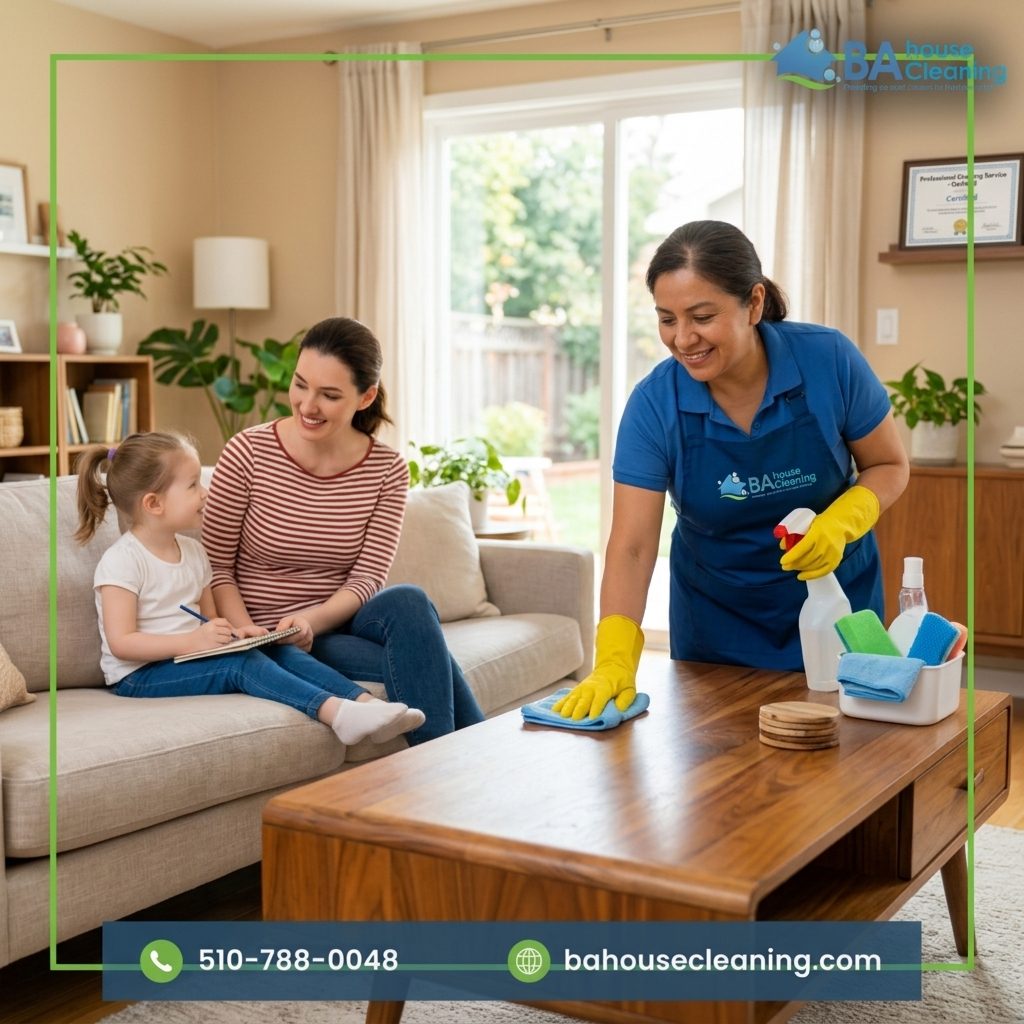
Between work commitments, school schedules, meals, and family responsibilities, keeping a home in order can become difficult to manage consistently. For some households, the answer is to hire an individual housekeeper. For others, a professional house cleaning company is a better fit.
Before hiring anyone, it helps to define what you actually need: ongoing household assistance, help with specific chores, or a team that handles agreed-upon cleaning tasks on a regular schedule.
This guide to hiring a housekeeper for busy families explains how to compare these options, establish expectations, assess reliability, understand costs, and choose household help that fits your family’s priorities.
Do You Need a Housekeeper or a House Cleaning Service?
The terms housekeeper and house cleaner are often used interchangeably, but the work arrangement can be quite different.
A private housekeeper may handle a broader range of household duties, depending on the agreement. A house cleaning service typically focuses on defined cleaning tasks performed according to a selected service scope.
Understanding this distinction before hiring can prevent misunderstandings about what is included.
| Option | Typically suitable for | What to clarify |
| Private housekeeper | Households needing ongoing, individually arranged household assistance | Cleaning, laundry, organization, working hours, responsibilities, and employment arrangements |
| Independent house cleaner | Households needing specific cleaning tasks from an individual provider | Tasks included, supplies, frequency, price, and responsibility for the work |
| Professional cleaning company | Households wanting a defined cleaning service without arranging every household responsibility individually | Cleaning checklist, service scope, scheduling, pricing, and who performs the work |
The exact responsibilities depend on the agreement and the provider. Cooking, laundry, childcare, errands, and household management should never be assumed to be included unless explicitly agreed upon.
For families whose main need is cleaning bathrooms, kitchens, floors, and other household surfaces, a professional cleaning service may be sufficient. If the household needs several additional duties, a private housekeeper may be more appropriate.
Start by Defining Your Family’s Needs
Before contacting providers, write down the tasks that create the greatest difficulty in your current routine.
This makes it easier to compare candidates and avoids paying for services that do not address your actual needs.
Identify the Tasks You Want Covered
Separate your requirements into three groups.
Essential tasks: Work that must be handled regularly, such as bathroom cleaning, kitchen surfaces, floors, or laundry if specifically included in the arrangement.
Occasional tasks: Jobs that arise less frequently, such as cleaning inside appliances, detailed cupboard cleaning, or preparing a home for visitors.
Additional household responsibilities: Duties such as meal preparation, errands, or childcare that may require different qualifications, arrangements, or service providers.
This list provides a useful starting point for discussing responsibilities. It also helps you identify whether you need a housekeeper with a broad role or a cleaning service with a defined scope.
Decide How Much Help You Actually Need
A household that needs help with several rooms once a month may not need the same arrangement as a large family with children and pets.
Think about which tasks you want someone else to handle, which you can manage yourself, and whether you need ongoing assistance or a one-time service.
Your goal is to find an arrangement that addresses the workload without making the agreement more complicated than necessary.
What to Look for When Hiring a Housekeeper
The right choice depends on more than availability. Consider the provider’s experience, communication, reliability, and ability to meet the responsibilities you have defined.
Relevant Experience
Ask whether the candidate has experience with the specific work you need.
For a cleaning-focused role, this may include maintaining bathrooms and kitchens, caring for common household surfaces, or following product instructions for different materials.
If the role includes additional responsibilities, ask about experience and qualifications related to those tasks rather than assuming that general cleaning experience is sufficient.
References and Professional Background
Ask for references where appropriate and seek permission to contact them. Useful questions include whether the provider was dependable, communicated clearly, respected household preferences, and completed the agreed-upon work.
If screening or background checks are part of your selection process, explain the requirements and ensure that any checks are conducted lawfully and appropriately.
Insurance and Responsibility for Damage
Understand who is responsible if something is damaged during the work.
When evaluating a cleaning company, ask about its insurance coverage and how it handles accidental damage or service concerns. For an individual hire, clarify any applicable insurance and responsibility arrangements.
Do not assume that every provider has the same coverage simply because they offer similar services.
Communication and Reliability
A good arrangement depends on clear communication.
Discuss how changes to the task list will be handled, how scheduling conflicts will be communicated, and whom you should contact if an issue arises.
A provider’s ability to explain the work and answer reasonable questions is an important part of evaluating whether the arrangement will suit your household.
Questions to Ask Before Hiring Household Help
Prepare a short list of questions before making a decision. This allows you to compare providers using the same criteria.
Consider asking:
- Which household tasks are included, and which are excluded?
- How are cleaning supplies and equipment provided?
- What experience do you have with the tasks we need?
- How do you handle delicate surfaces, valuable belongings, and special care instructions?
- How are visits scheduled, changed, or cancelled?
- How is the cost calculated, and what could lead to additional charges?
- Who will enter the home, and what screening or insurance arrangements apply?
- How should we report a concern or request a change to the agreed-upon work?
You do not need identical arrangements from every provider. The purpose of these questions is to understand the differences before deciding which option best meets your requirements.
How to Establish Clear Expectations
Even a reliable provider can misunderstand a household’s priorities if the agreement is vague.
Before the first visit, write down the tasks that matter most and explain any special requirements.
Create a Clear Task List
For cleaning-focused work, a task list might identify the rooms to be cleaned, the surfaces included, and any tasks that require separate approval.
For example, routine cleaning may include wiping accessible surfaces and maintaining floors, while detailed appliance interiors or other specialty work may be additional tasks.
A written list helps both parties understand the scope and makes it easier to discuss changes.
Explain Household Preferences
Tell the provider about important household considerations, such as preferred cleaning products, areas that should not be disturbed, pets, access arrangements, and fragile belongings.
If a surface requires a particular cleaning method, share the manufacturer’s care instructions when available.
Providing this information in advance reduces uncertainty and helps establish a consistent approach.
Agree on Communication
Decide how appointment reminders, schedule changes, access details, and feedback will be handled.
It is also helpful to identify a primary contact person, especially in a busy household where several family members may have different schedules.
A simple communication process can prevent small misunderstandings from turning into recurring problems.
How Much Does Hiring a Housekeeper Cost?
The cost of household help depends on the arrangement, the work involved, and the provider.
A private housekeeper may charge by the hour, by the day, or according to another agreed-upon arrangement. A professional cleaning company may price its services according to the property, cleaning level, frequency, and tasks selected.
When comparing estimates, make sure that you are comparing similar work rather than choosing solely on the quoted amount.
Consider the following factors:
- The size and condition of the home.
- The number and type of tasks required.
- How often the service is needed.
- Whether supplies and equipment are included.
- Whether additional work is priced separately.
- Cancellation, rescheduling, and payment terms.
Ask for a clear description of the work and the expected cost before committing.
If you hire an individual directly, the employment and tax considerations may differ from hiring an independent business. The Internal Revenue Service’s guidance on household employees explains how worker classification depends on the actual working relationship, including the degree of control over the work.
This is an important distinction to clarify rather than assuming that every person providing household services is automatically an independent contractor. Consult official guidance or a qualified tax professional if you are unsure about your responsibilities.
How to Evaluate a Cleaning Company for Your Family
If your main priority is maintaining a clean home rather than managing a broad household role, a cleaning company may offer a more straightforward arrangement.
Use these criteria to compare providers.
Defined service scope: Confirm which rooms and surfaces are included, as well as any exclusions or add-on services.
Staffing and reliability: Ask how visits are assigned, how schedule changes are handled, and what happens if a team member is unavailable.
Insurance and accountability: Understand the provider’s coverage and process for handling damage or service concerns.
Transparent pricing: Confirm what information is needed for a quote and whether the price can change when the scope changes.
Communication: Check how to contact the company, request a change, or raise a concern after a visit.
Service fit: Choose a provider whose advertised services match your actual needs rather than assuming that every cleaning company performs laundry, cooking, childcare, or other housekeeping duties.
For general advice about comparing providers and checking references, the Federal Trade Commission’s consumer guidance on selecting service providers offers useful principles about researching businesses and clarifying written terms. Although it focuses on home improvement, some of its advice about evaluating service providers can be applied more broadly.